One of the demos that I show when I talk about AND dependencies in a Windows Server Failover Cluster is moving a SQL Server resource group (or role as of Windows Server 2012 and higher) to a different cluster node. During the failover, I highlight that the SQL Server cluster resource will not come online until […]
PostThe Lion, The Switch and The Wardrobe on Disaster Recovery
While promoting my online virtual class a few days ago, several people asked me about a module that caught their attention – The Lion, The Switch and The Wardrobe. The title of the module was based off of one of the Narnia movies. Since it caught their attention, I started explaining the contents of the module in […]
PostIs a Successful Backup Really a Successful Backup?
There are two common types of backups performed on SQL Server databases. The first is the native backup type that is commonly taken using either the out-of-the-box database maintenance plans or a custom backup script. The second type is that which is taken by third-party backup tools – be it an enterprise-wide backup tool or a SQL […]
PostBuilding a Portable Hyper-V Lab On A Budget Part 2
In a previous blog post, I walked you thru how I built my portable Hyper-V lab using Gigabyte’s GB-BXi5-4570R mini barebone PC. I even had a chance to test it out immediately after getting it all configured. I brought the kit with me to Microsoft’s Big Data Hackathon event in Toronto. And, boy, I surely don’t miss the heavy […]
PostBuilding a Portable Hyper-V Lab On A Budget Part 1
As an IT professional, it is important to have a lab environment to play around with – whether you’re a developer writing code or a systems administrator building servers – to test ideas and concepts prior to doing it for reals. Time and time again, I’ve heard folks say how expensive it is to build […]
PostHow To Identify Potential Data Loss When DBCC CHECKDB Reports Corruption – The Simple Way
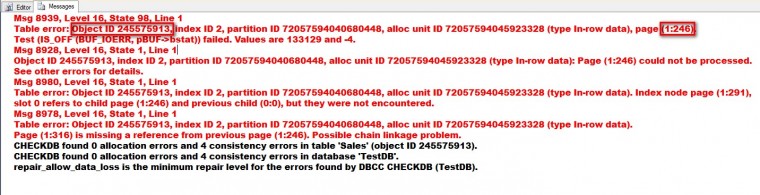
A few days ago, one of my customers reached out to me on Instant Messenger and asked how to identify what the potential data loss is when DBCC CHECKDB reports corruption of a SQL Server database. My common response is the usual “it depends” in that there are cases when DBCC CHECKDB may recommend using the option REPAIR_ALLOW_DATA_LOSS. […]
PostHelpful Techniques on SQL Server Database Recovery
This video is a compilation of different database recovery techniques that SQL Server DBAs should be familiar and comfortable with. We will look at recovering a database to a specific point in time, isolating critical objects or using table partitioning as an HA/DR option (more commonly called online piecemeal restore) and performing page-level restores. I […]
PostGiving away FREE Access to my SQL Server High Availability and Disaster Recovery Deep Dive Course – Round 2
Last year, as part of launching my very first online course, I gave away FREE access to my SQL Server High Availability and Disaster Recovery Deep Dive Course. I’m doing it again this year but with a totally different reason. Here’s why. I’ve been very active in the SQL Server community in one way or another. […]
PostInstalling, Configuring and Managing Windows Server Failover Cluster using PowerShell Series
Last year, I started writing an article that was supposed to be a series for Installing, Configuring and Managing Windows Server Failover Cluster using Windows PowerShell. The first of the series came out on July 2013 (which ended up being the last article I wrote for the year 2013 on MSSQLTips.com.) Since then, I’ve been involved […]
PostWhy Regular Shrinking is NOT the Right Way to Reclaim Database Space in SharePoint – nor in any SQL Server database

I recently got a question about how to reclaim database space in SharePoint. The specific database mentioned was WSS_Logging although this could have been any of the SharePoint databases or any other SQL Server database for that matter. The database was growing really fast so the farm was configured to only keep a week’s worth […]